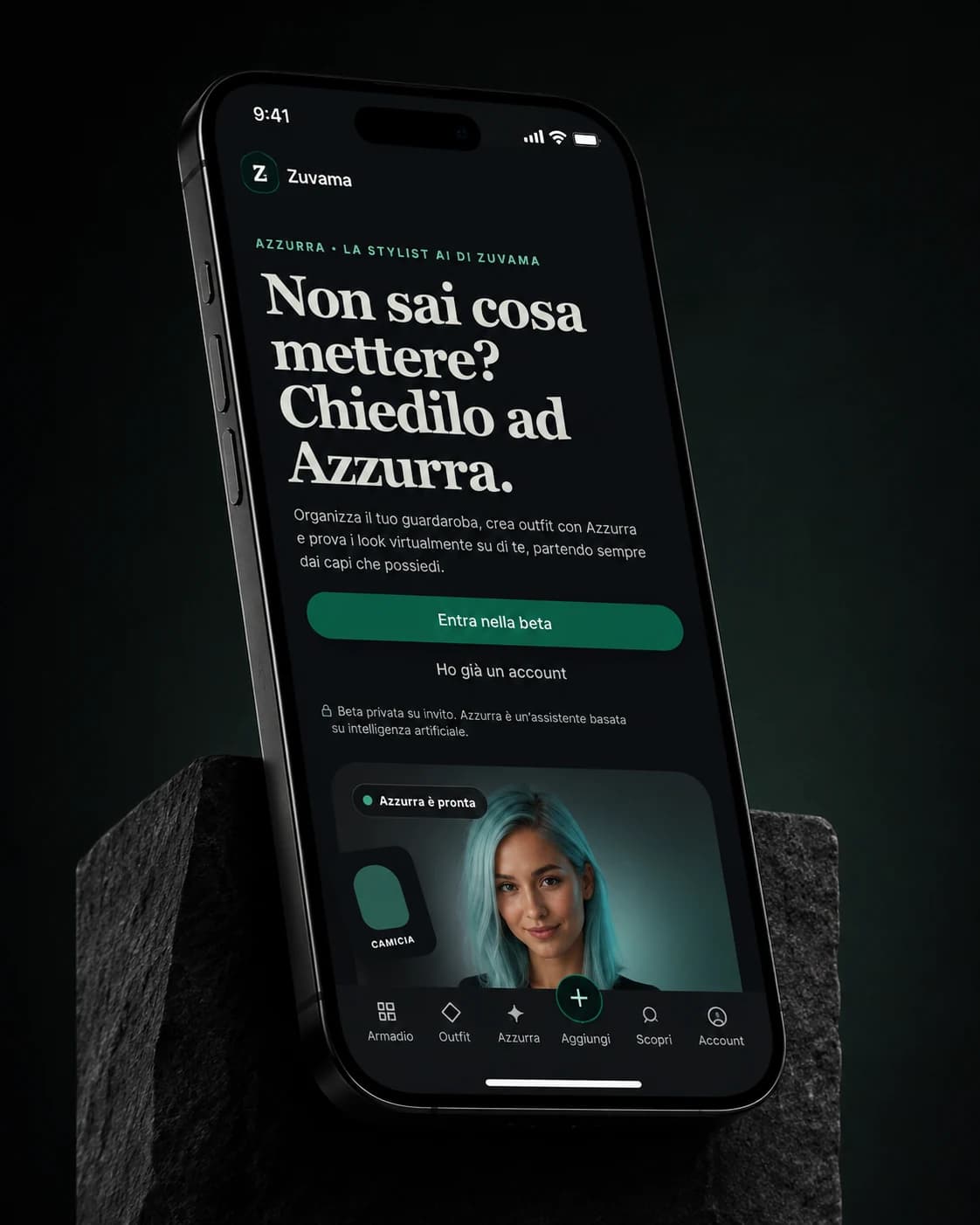
Digital wardrobe
Camera-first capture, clothing catalog, favourites, wear history, laundry state and manual e-commerce import.
Case study · Product engineering · 2026
A digital wardrobe that turns clothes, context and personal preferences into easier style decisions — using AI only where it creates real value.
01 · The problem
Most people already own enough clothes. The harder problem is remembering what they have, combining it better and choosing quickly for the context they are in.
Zuvama is designed to reduce that friction: bring the wardrobe into a useful digital memory and turn it into concrete suggestions without replacing the user's own taste.
02 · The product
The experience is designed to work as a useful product first and as an AI product second.
Camera-first capture, clothing catalog, favourites, wear history, laundry state and manual e-commerce import.
Outfit creation and planning, calendar, mood and contextual hints connected to weather and city when the user chooses to share them.
Azzurra as a persistent stylist and an asynchronous virtual fitting room to preview outfits while preserving identity and garment characteristics.
03 · AI with a job to do
I did not want a chatbot placed on top of a wardrobe. I separated two different problems: deciding what to recommend and visualising how an outfit could look.
Azzurra · Stylist
A persistent text stylist built around the user's wardrobe and profile, with per-user AI budget control and usage accounting.
Virtual Try-On
Asynchronous generation with multiple references: the person's photo plus outfit garments. Moderation, retention and source-photo cleanup are part of the flow, not later add-ons.
04 · Engineering
The technical direction favours an architecture that stays readable, observable and simple enough to evolve without premature infrastructure.
Core stack
Asynchronous AI flow
05 · Trust by design
When a product handles personal photos and generative AI, trust cannot depend on a footnote.
Private storage and controlled access to results
Moderation before AI generation
Per-user budget and AI usage audit
Explicit retention for generated results
Source-photo deletion after virtual try-on
Technical telemetry without turning the product into surveillance
06 · My role
Zuvama is where I bring together the way I like to work: product thinking, engineering, UX, AI and operational discipline.
I drove product definition and priorities, architecture direction, responsive UX flows, AI feature integration and the hardening work required to turn a prototype into a beta that real people can use.